
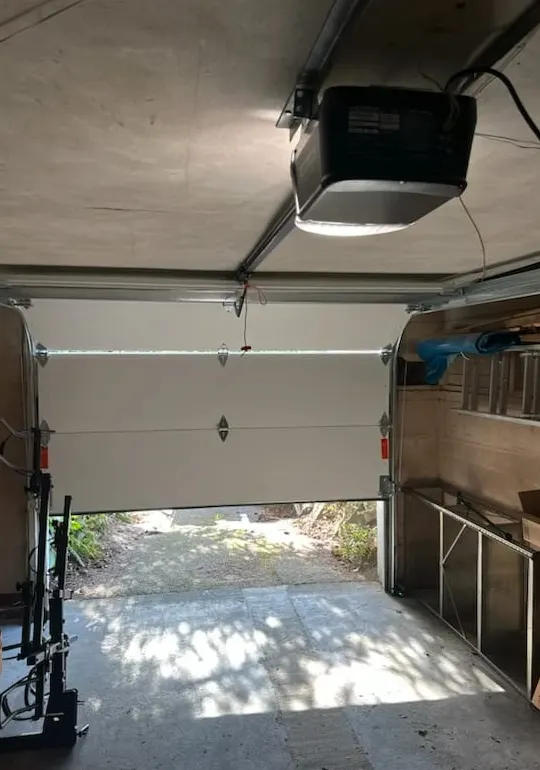
You're Already Backing Out of the Driveway
It happens on a Tuesday morning, usually when you're running late. You're halfway to Granite Avenue before you start wondering if you actually pressed the button on the way out, or if the door is sitting wide open while sleet blows into the garage. Maybe you turn around to check. Maybe you don't, and you spend the whole day half-thinking about it. That moment, more than any sales pitch, is what smart garage door openers are built to fix.
But "smart" has become a catch-all term slapped on everything from a $150 opener to a $600 one, and not all of it is useful. Here's what these things actually do once they're installed, and what's worth paying for.
What a Smart Opener Actually Does Day to Day
Strip away the marketing and a smart garage door opener does three things reliably:
- It tells you the door's status from your phone — open, closed, or stuck halfway — without you having to look at it.
- It lets you close it remotely if you forgot, which matters more in winter when an open garage means snow blowing onto your car and heat bleeding out of any attached living space.
- It logs activity, so you can see that the door opened at 7:42 a.m. when your kid left for school, or that it's been sitting open since noon for no good reason.
Everything else — voice control, camera integration, scheduling — is built on top of those three core functions. If a feature doesn't trace back to one of those, it's probably not why you're buying this.
Features That Actually Matter Here
Battery Backup
Nor'easters knock out power, sometimes for a day or more. A battery backup keeps the opener functional during an outage, which matters if your garage is your only way in and out, or if you've got a car you need to move before a plow comes through. This is one feature worth insisting on, not skipping to save money.
Cold-Rated Components
Not every opener is built the same for sustained cold. Look for one with a motor and logic board rated for the temperature swings you actually get — freeze-thaw cycles are hard on seals and sensors, and cheaper units sometimes develop sensor glitches or slow response times once it's consistently below freezing.
Manual Lock Override Compatible with the App
If you ever manually lock the door from inside (common in older homes where the garage connects to the house), make sure the app can tell the difference between "closed" and "closed and locked." Some cheaper systems can't, and you'll get a false sense of security.
Real-Time Alerts, Not Just Status
You want a push notification the moment the door opens unexpectedly, not just the ability to check status when you remember to. The alert is the actual safety feature; the status check is just a convenience.
Wired Sensor Option
Wireless door-position sensors are standard, but in a garage that gets humid in summer and salty, slushy grime tracked in all winter, a wired sensor tends to hold up longer than a battery-powered wireless one that corrodes or drains faster than expected.
Features Worth Ignoring
- Built-in cameras — most homeowners already have a doorbell camera or exterior camera covering the driveway. Paying extra for a lower-quality one built into the opener rarely adds much.
- Voice assistant integration — nice to have, rarely used after the first month, and not worth paying a premium for on its own.
- Elaborate scheduling features — "auto-close at 10 p.m. every night" sounds good until you have a late guest or a teenager coming home from practice. Most people turn this off within weeks.
Questions to Ask Before You Buy
This is where older housing stock matters. A lot of homes in this area still have the original garage door and track system, sometimes decades old. A smart opener is a separate unit from the door itself, but compatibility still depends on a few things:
- What's my current door's weight and balance like? An opener has to be sized correctly for the door it's lifting. A heavier original wood door needs a stronger motor than a standard steel one.
- Are my springs in good shape? A smart opener won't fix a door that's struggling because of a failing spring — it'll just make the struggle more obvious, faster, and it'll shorten the opener's lifespan trying to compensate.
- Does the existing track and rail system support a belt-drive or chain-drive opener? Older tracks sometimes need minor adjustment to work smoothly with a new unit.
- What's the Wi-Fi signal like in the garage? Detached garages or garages at the far end of a house sometimes have weak signal, which undermines the whole point of a smart opener.
Asking these before you buy saves you from installing a smart opener on a door system that isn't ready for it.
When to Call Milton Garage Door
If your current door is struggling, noisy, or slow before you even add a smart opener into the mix, that's the first thing to address. We handle garage door opener repair and installation, and as part of that we'll check your spring tension, track alignment, and door balance before recommending a specific opener, since a smart unit installed on a door that's already fighting its springs just means more wear and more service calls down the road. If you're not sure whether your current setup can support an upgrade, that's a quick, straightforward thing for us to look at.
If you're in Milton, Quincy, Braintree, Canton, Dorchester, Randolph, Dedham, or Weymouth and you're thinking about upgrading your opener before winter really sets in, give Milton Garage Door a call. We'll tell you straight whether your door is ready for it.